

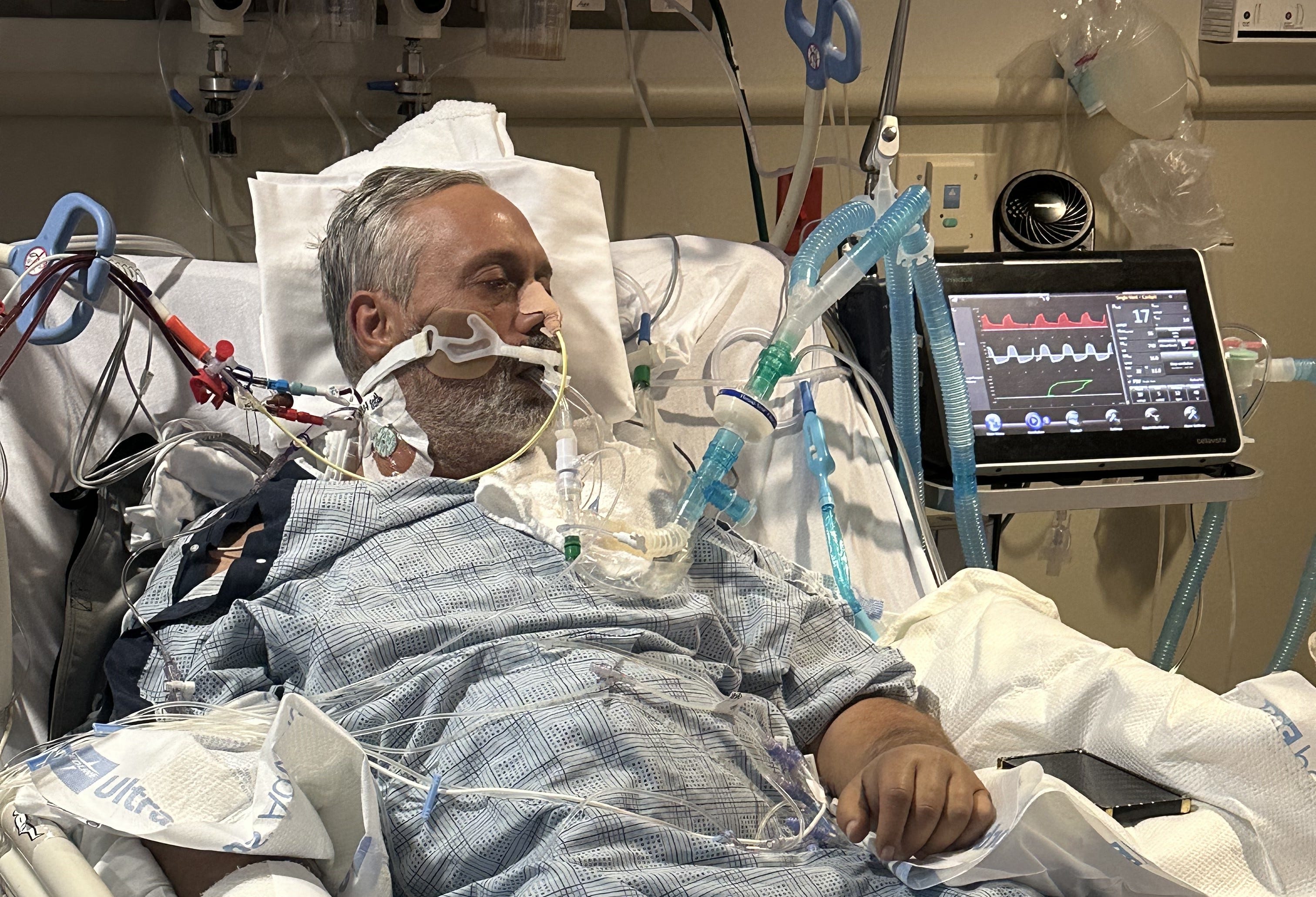
I met Shane in an ECMO survivor support group. His story stopped me. I reached out and asked if he’d be willing to share it here, and he said yes. What follows is his account of what it felt like from the inside — waking, recovering, and understanding what his team had done to keep him alive.
Shane went to bed one night thinking about the coming weekend. Hours later, he was in cardiac failure, on a ventilator, then on ECMO. What followed was survival — and a journey most clinicians never fully see from the patient’s side.
When Shane woke from the coma, nothing made sense. His world had shrunk to a narrow strip of glass, six feet by two feet. He couldn’t speak. He couldn’t move. He was losing track of words halfway through sentences. “I felt small, like I had lost something fundamental,” he writes.
But one thing stood out to him: the advocate at his bedside. His partner asked what they were giving him. Why. What each step meant. “Those questions helped bring clarity in the middle of chaos, when everything was moving quickly, and understanding felt just out of reach.”
Shane’s recovery took him through complications most of us hope our patients never face. He lost a leg to the brutal tradeoff of pressors. He gained forty pounds of fluid. He had to relearn how to breathe.
And here’s what he understands now that matters most for your team: “No one comes back from something like this alone. Survival does not belong to one person. It belongs to the families who stayed, the friends who hoped, and the doctors, respiratory therapists, nurses, techs, specialists, and teams who never gave up, even while living through hell themselves and praying for a miracle.”
That’s professional knowledge. Your patient sees it. They feel it. They remember it.
Read Shane’s full story on ECMO 143: A Patient & Family Guide, my free patient and family resource for anyone navigating ECMO.
Learn more
For a deeper dive into ECMO for professionals, subscribe to this Newsletter ECMO 143: AI-Assisted Journey, a free resource for specialists and trainees.
I also built AI ECMO Educator, a free Custom GPT providing evidence-based guidance on physiology, cannulation, anticoagulation, circuit management, and troubleshooting. Built on ELSO, PubMed, AmSECT, and leading centers. Version 5.2 | Supports 50+ languages.